Rummy FAQ: When Is a Safe Discard Still Too Expensive?
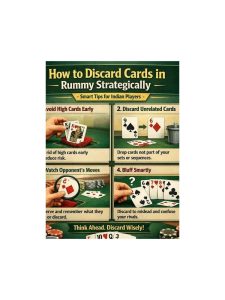
A card may appear unlikely to help another player and still be the wrong discard. Safety is only one part of the decision. You must also consider what the card contributes to your own routes, how many alternatives remain, and what penalty you carry after removing it.
Start by defining safe in practical terms. You cannot know another player’s complete hand, so “safe” usually means the card does not obviously continue a visible route or match a recently collected pattern. That evidence is useful but limited. A quiet card can still be valuable to someone else.
Now compare the card with your alternatives. If discarding it breaks your only flexible sequence, you may be exchanging a small theoretical risk for a large certain loss of structure. If the alternative is a high isolated card with no realistic home, the high card may be the better discard even if its visibility makes you uneasy.
Consider the stage of the hand. Early on, preserving flexibility may justify keeping a card that is not immediately useful. Later, a card that has not improved may become too expensive to protect. The same card can therefore be a sensible keep in one turn and an overdue discard in another.
Use a three-part sentence before deciding: “This card supports __; the alternative costs __; the visible evidence against it is __.” If the support is strong and the evidence is weak, do not discard merely to appear safe. If the support is narrow and another card clearly carries more potential cost, let it go.
Good decisions do not require certainty about opponents. They require a balanced comparison between your own structure and the information available. A safe discard is helpful, but it should never be allowed to hide the larger question: which choice leaves your hand in the best position for the next turn?
If you repeatedly choose a technically safe card that damages your route, review the pattern rather than memorizing one fixed rule. You may be overreacting to visible clues or underestimating the value of a flexible connector. A small note after the round—what you protected, what you gave up, and what you knew—can reveal which side of the comparison needs attention.