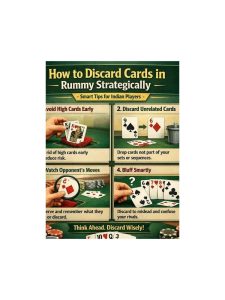
Rummy FAQ: Should Every Card Support the Same Plan?
It is useful to look for a common direction in a rummy hand, yet perfect alignment is not always realistic. Early cards may support different routes, and one flexible card can preserve a valuable alternative. The goal is a coherent hand with controlled uncertainty, not a hand in which every card must fit one story immediately.
Separate confirmed structure from temporary support. Confirmed sequences or sets deserve protection because they already solve part of the hand. Temporary cards can support a primary route, a fallback, or a low-cost exit. The important point is that each temporary card has a reason for staying and a time when that reason will be reviewed.
A narrow plan becomes risky when it needs several exact cards. If the plan requires multiple missing connections, keeping unrelated cards just because they might fit later can increase both point exposure and confusion. In that situation, a small amount of deliberate flexibility may be healthier than total commitment. Preserve the card that supports two credible routes, not every card that supports one remote possibility.
On the other hand, excessive flexibility can become clutter. If every card is defended as an alternative, no discard has a clear priority. Use a simple test: can you name the best route, the fallback route, and the card most likely to leave next? If not, the hand probably needs simplification.
Timing changes the answer. Early in a hand, a mixed shape may be appropriate while information accumulates. Later, the cost of unresolved cards rises and a more unified plan usually matters. A card that deserved protection at the opening may become the weakest card after several turns.
So every card does not need to support the same plan. Every card should, however, have a current role and a review condition. That balance creates flexibility without allowing uncertainty to spread through the entire hand.
One practical arrangement is to keep confirmed groups together, place the primary route beside them, and put the fallback at the edge of the hand. This physical separation makes the status of each card easier to see. It also reduces the chance that a temporary connection will be mistaken for a completed group during a hurried declaration. The arrangement is only an aid, not a rule. Move cards when new evidence changes their role, and verify the result against the applicable format. A tidy layout is helpful because it exposes relationships; it is not proof that the hand is complete or legal.