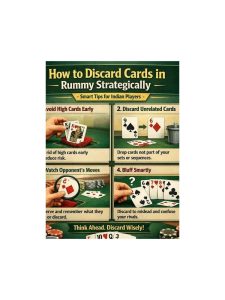
Rummy Guide: Turn a Messy Opening Hand Into Three Options
An opening hand can look disappointing when its cards do not immediately form a neat sequence or set. The useful response is not to force the first attractive pattern. Instead, turn the hand into three possible options and compare them with the same questions.
First, separate cards that already have support from cards that are isolated. A connected pair, a same-rank pair, or a card with several nearby possibilities belongs in the useful group. A high card with no visible relationship belongs in the review group. This simple sort prevents one exciting pair from hiding the rest of the hand.
Next, write three routes in plain language. One route might be a sequence built around a connected pair. Another might use a repeated rank to form a set. The third can be a low-commitment route in which you keep flexible cards while discarding the most expensive isolated card. The routes do not need to be equally likely. They only need to make the alternatives visible.
For each route, ask how many cards could improve it, how many turns it may need, and what it forces you to keep. A route that needs one of several cards is healthier than one that depends on a single exact card. Also consider whether keeping the route leaves you with a dangerous high card or too many unrelated pieces.
After the next draw, update the comparison. Do not defend a route because it was your original idea. If one option gains support and another loses its only connection, change plans. This is not indecision; it is using new information.
The three-option method is especially useful in practice games. It trains you to notice structure before chasing a lucky card, and it gives every discard a reason. The goal is not to predict the exact winning hand. It is to keep a workable path open while reducing the cost of being wrong.
You can make the comparison clearer by assigning each route a next action. A route might say “keep the connector and release the high singleton,” while another says “protect the pair for one more draw.” A route without a next action is only a description, not a plan. Revisiting these actions after each draw keeps the hand responsive instead of letting the opening idea control the entire game.