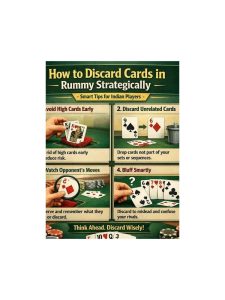
Rummy Strategy: Use Low-Information Turns to Improve Structure
Not every turn provides a dramatic clue. Sometimes the draw does not help, the discard is ambiguous, and the other players reveal almost nothing. A low-information turn is still useful if you use it to improve the hand’s structure rather than waiting passively for certainty.
Begin by choosing the weakest current card using three measures: connection, flexibility, and penalty. A card with no practical route, few future homes, and a costly value is a strong review candidate. You do not need a perfect prediction to release it. You need a better comparison than keeping it by default.
Next, reduce route overlap. If two speculative plans depend on the same missing card, keep the plan with the stronger surrounding support and release the weaker piece when possible. This makes the next draw easier to interpret because fewer ideas are competing for attention.
Use the turn to improve organization as well. Sort cards consistently by suit or rank, keep confirmed groups visually separate, and ensure that a flexible connector is not hidden among unrelated cards. Clear layout cannot change the deal, but it can reduce misreads and hurried discards.
Review the hand’s requirement. If a pure sequence or another legal condition remains missing, move that need to the front of the comparison. A quiet turn is a good time to notice that a comfortable-looking set does not solve the main structural problem. Adjust the plan before the hand becomes late.
Avoid inventing certainty from silence. An opponent’s discard may be uninformative because they had several reasonable choices, not because you have discovered their plan. Keep observations modest. Your own structural improvement is usually more dependable than a detailed story about another player’s hidden cards.
One low-information turn rarely decides a hand. It can, however, decide whether the next turn begins with a clean comparison or a crowded collection of unresolved hopes. Use the quiet turn to lower clutter, control penalty, and make the remaining routes easier to evaluate. That is progress even when no card looks exciting.
Small structural gains compound across turns. Removing one weak route can make a later useful draw obvious, whereas a crowded hand may hide the same opportunity behind several competing ideas.
The discipline is especially valuable when the table feels slow. A quiet turn can tempt you to invent a signal, but improving your own arrangement is a concrete action that does not depend on guessing what others hold.